

Creating real value with AI (in hospitality)
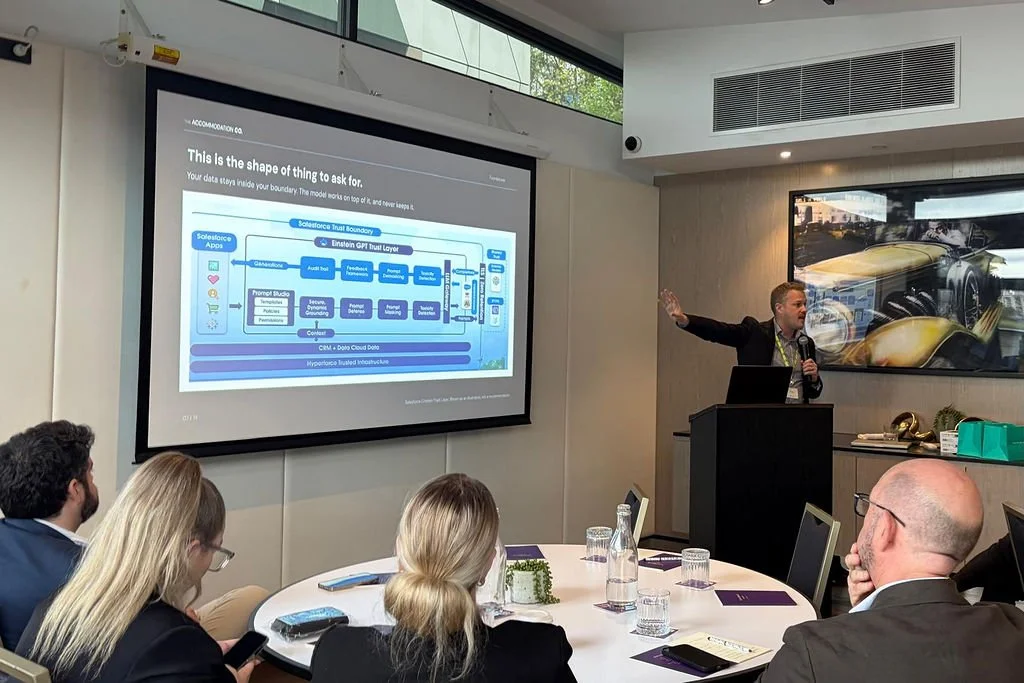
I first presented this to a room of revenue managers and operators at the Revenue Strategy Seminar in Brisbane, hosted by Duetto and RMS Cloud at Crystalbrook Vincent.
Almost every operator I talk to is under pressure to do something with AI. The GM wants it, the owners want it, and every hiring decision now quietly carries a line asking whether AI could do this instead.
Most of them are already using it, too. Emails, summaries, a second opinion on the day's pick-up. The Mews Hotelier Survey for 2026, covering more than 500 properties, put it at 98% of hoteliers having used AI somewhere in their operations in the past six months.
Then there is THAT other number: MIT's State of AI in Business found 95% of enterprise AI pilots delivered no measurable impact on profit within six months. That was 52 executive interviews, 153 leaders surveyed and 300 deployments.
So the question isn't whether to use AI or not, everyone us already using it. The question is why so little of it ever makes a real economic impact.
The 5% reported in the MIT’s State of AI in Business research that did work, had three things in common:
1.) They picked one problem instead of launching a programme.
2.) They were careful about who they picked as partners.
3.) And they started in the back office, not the front of house. Budgets go to sales and marketing, the returns keep showing up in admin.
For accommodation businesses I'd add that there are three conditions that have to be true before any of it works, and most operators are being sold the tool long before any of them are in place.
Your AI problem is usually a data problem
If your data is scattered, the AI will be confidently wrong and you won't know until you are presenting it in front of owners, stakeholders or your colleagues.
You end up having every team member uploading the same spreadsheet over and over. It doesn't scale but more importantly, it isn't safe. In the end everyone ends up working from a slightly different version of the truth.
The part isn’t often discussed is how confident these tools are. AI won't easily tell you it's missing data, it'll give you a clean, plausible but unfortunately often wrong answer instead.
Worth saying the pain here is rarely between the PMS and the RMS. That's exactly what the good revenue and property platforms already solve. The mess sits in everything around the core: owner reporting, F&B, parking, the direct booking site, the CRM, the spreadsheet someone built in 2019 that half the team still relies on. That's where the reconciliation happens by hand, and that's where an AI tool will quietly get it wrong.
Three things I'd ask for before switching anything on:
One governed source your tools read from, not ten copies of it
Written terms that your data never trains a public model
A clear answer on where the data physically goes
What you're looking for is the model working on top of your data inside your own boundary, and never keeping it. The Salesforce Einstein Trust Layer is a good illustration of that shape. Most serious platforms now have something equivalent, and if a vendor can't draw you their version of it, they probably haven't built one.
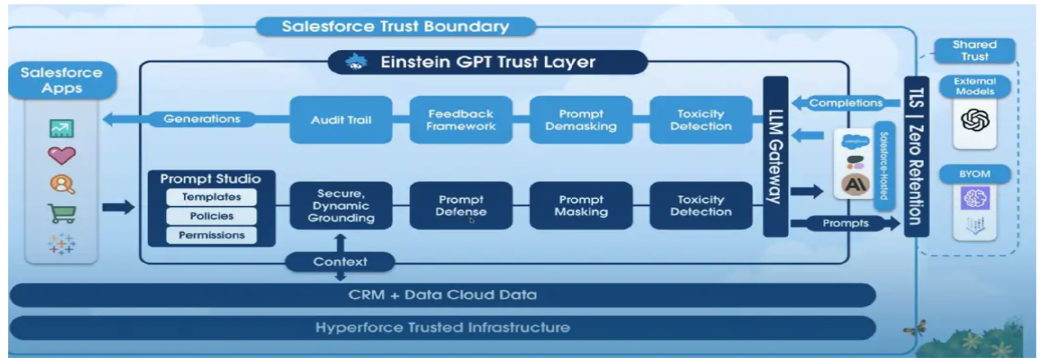
Salesforce Enstein Trust Layer
There is a second reason this matters: The Verizon Data Breach Investigations Report for 2026 found the share of workers using AI tools on company devices went from 15% to 45% in twelve months, and two thirds of them were using personal accounts. This isn’t your team being wreck-less, they are trying to finish the job with the tools they have access to.
If you haven't given your team a safe way to do this, you haven't stopped it happening, you've just stopped being able to see it.

Start with the work nobody wants to do
A fully AI-run hotel sounds impressive but guests often still want to interact with people. Chatbots are excellent right up until they misunderstand, don’t do what the guests asks for, and often left unsupervised they'll find the edge case in front of that one difficult guest.
My recommendation is to start with the repetitive work instead. That one report someone rebuilds every Monday, or the data someone re-keys from one system into another frequently. Think about the owner statement that takes two days a month.
Take that off the team and let them spend the hours on guests, or on the one analysis they never get around to but that could improve your bottom line substantially.
Unfortunately, It won't win you AI Implementation of the Year award at your local Chamber of Commerce but it does creates actual value. From there you can always expand something that works, whereas unwinding something you rolled out everywhere is much harder.
The number I keep coming back to is from that same Mews survey. 59% of hoteliers think the welcome and check-in should stay human-led, and that view is strongest among the properties using AI the most. The people drawing that line are the heaviest users, not the sceptics. The more experience people get with these tools, the sharper their instinct for where they don't belong.
The software you build yourself is the risk you can't see
AI has provided a whole new opportunity to operators, to create small pieces of software by using AI. Vibe coding (as it is called) is describing what you want in plain English and letting AI write the software for you. I use it, I love it and It's genuinely remarkable. It is how a lot of operators are now solving small but unique problems that no vendor was ever going to solve for them.
It comes with its own set of risks: at any kind of scale you become the only person who understands how the thing you created works. What happens when you're on leave or what happens when you leave. You set out to create value but you created a dependency instead, and now nobody can maintain it or audit it, while it's holding a piece of your operation together.
Then there's the code itself. Veracode tested more than 100 models and found 45% of AI-generated code introduced a known security vulnerability, a rate that didn't improve from 2025 into 2026. A separate scan of 1,400 production applications built this way found 65% had security issues, including exposed customer data. The bigger models didn't do any better: they've got better at writing code that works, without getting better at writing code that's safe.
Two things help: build in working groups across departments rather than alone, because you get better answers and the knowledge doesn't sit with one person and treat AI output like third-party code, so read it, test it and review it before it goes anywhere near a guest or an owner.
What I'd do first
Find out where your data actually is, before you buy anything. If you can't answer that question, no tool is going to fix it for you.
Give your team a safe way to use AI. They're already using it, the only real question is whether you can see it.
Automate one boring thing. One task, done properly, then decide whether to do the next one.
Actual value is created when the AI still works after the person who built it has left. That's the test I'd apply to anything you're being sold at the moment, and it's a harder test to pass than most of what's currently on offer.

Thanks to Duetto and RMS Cloud for putting the session together, and to everyone who stayed on the terrace afterwards. The conversations after these things are usually better than the talks. If you're working through any of this in your own business, I'm always happy to talk it over.
